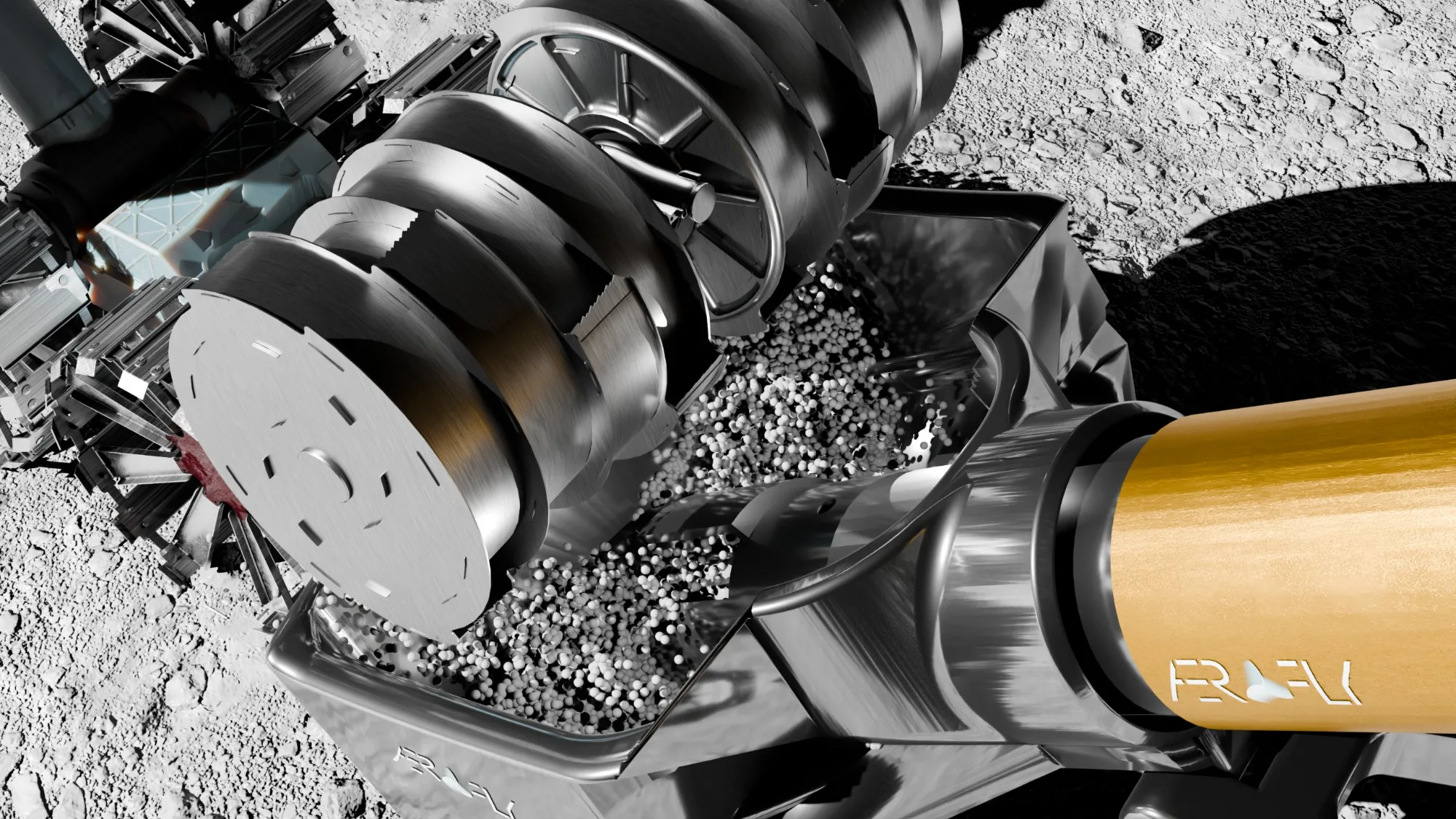
How Rego-LIFT moves regolith
Rego-LIFT is an auger conveyor for lunar regolith, built in modular sections. Take one apart, watch it run beside a conventional screw conveyor in simulation, and see how lunar gravity changes the job.
Moving regolith is the first problem of lunar industry.
Before water can be extracted or oxygen produced, regolith has to move: reliably, continuously, and at scale.
Lunar regolith is hard to move. On Earth, water rounds soil grains until they roll like tiny ball bearings. On the Moon, micrometeorite impacts have smashed volcanic rock into jagged fragments that grind against each other and against any machine that carries them.
Take it apart.
This is the portable configuration: a single auger on a wheeled frame. An excavator rover drops regolith into the intake at the low end, and the auger carries it up to the discharge at the top.
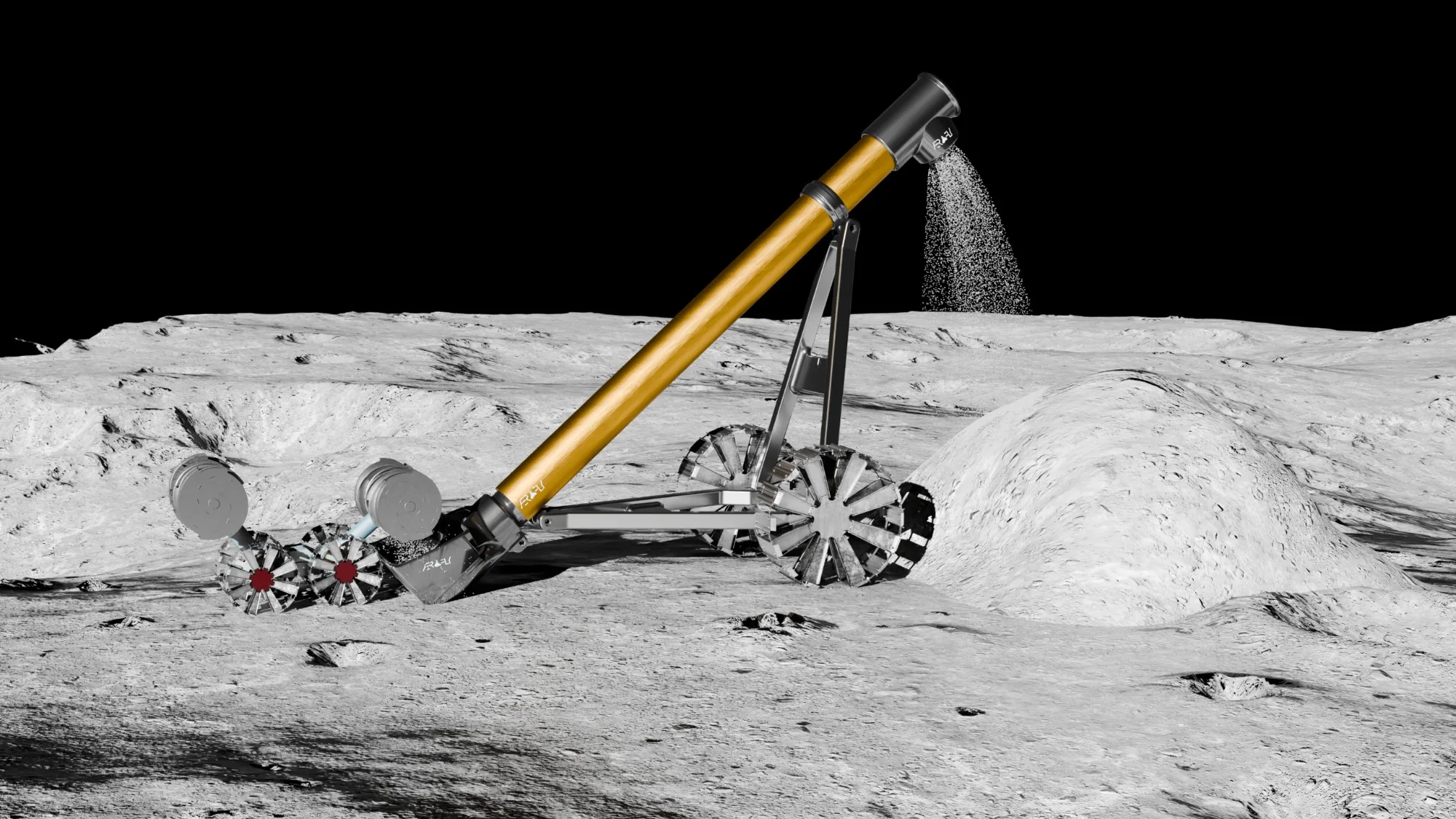
Pull it apart
Drag the model to turn it. Separate the parts, then cut the tube open to see the flight inside.
AeroFly CAD model of the portable Rego-LIFT, rendered in your browser.
The blade stays still. The tube turns.
An auger is a helical blade, called the flight, inside a tube. Rego-LIFT is derived from the grain augers used on farms, where the flight turns inside a fixed tube. That conventional design is a screw conveyor. Lifting material straight up is harder than moving it along a slope: grains tend to spin with a turning flight instead of climbing it.
Rego-LIFT reverses the roles. The flight is fixed and the tube rotates. Friction with the turning wall carries grains around, and the fixed flight acts as a spiral ramp that turns that motion into lift. AeroFly's testing found that a stationary auger in a rotating tube moves more material vertically than a rotating auger in a stationary tube (Aerospace America, April 2026 ↗).
In simulation, at the same size and speed, Rego-LIFT lifts a steady stream of about 130 g/s where a conventional screw conveyor stalls.
Screw conveyor
Flight turns, tube fixed
- Delivered
- 0 g
- Throughput
- 0.0 g/s0 kg/h
- Tube fill
- 17%
End of the run · rates over its last 3 s
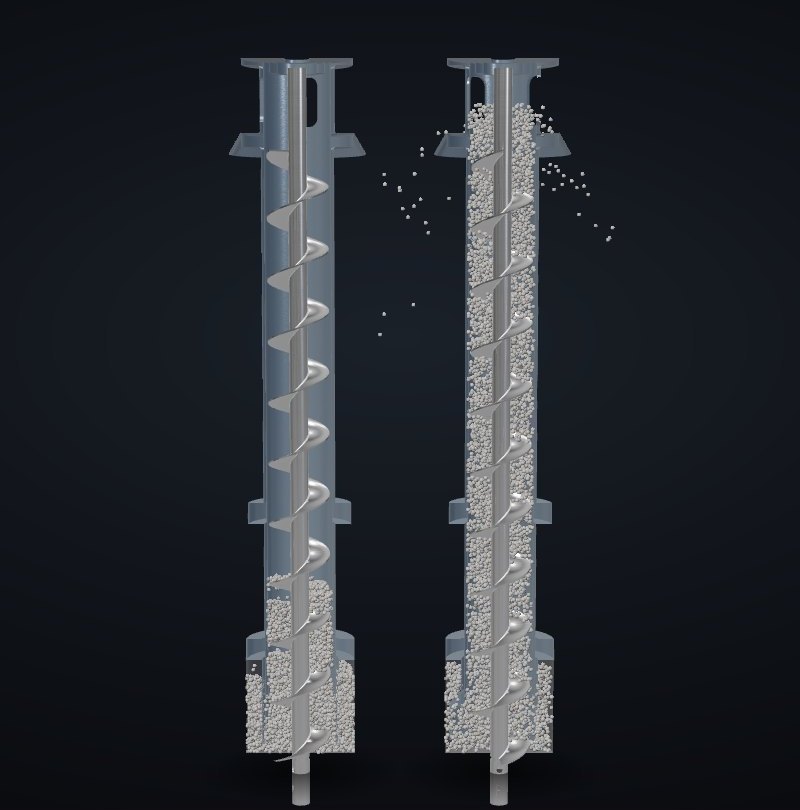
Rego-LIFT
Tube turns, flight fixed
- Delivered
- 1.16 kg
- Throughput
- 129.7 g/s467 kg/h
- Tube fill
- 98%
End of the run · rates over its last 3 s
Delivered at the outlet as a steady stream, about 467 kg/h, averaged over the last 3 s of the run.
Nothing delivered in 30 s of simulated time. The material climbed about 180 mm up the tube and never reached the outlet.
Discrete element simulation (Project Chrono DEM-Engine) in lunar gravity (1.62 m/s²), using TechLeap sub-scale geometry about 0.7 m tall. The grains are 2 mm glass beads with uncalibrated contact parameters (glass-bead defaults), so compare the two machines with each other rather than reading the absolute rates as Rego-LIFT performance. Both machines are fed from the same flooded intake and start empty at t = 0. Drive power is the granular load on the driven part only, without bearing, seal or motor losses. The cup at the bottom is the simulation's intake wall, not CAD. No outlet chute is modelled: delivered grains fly out of the head ports and leave the model below 0.40 m. Only a sample of the grains is drawn, enlarged.
From start-up to steady flow.
Both machines start empty and are fed from the same flooded intake. In Rego-LIFT the material column climbs the tube at a steady rate, the first material reaches the outlet at 22.8 s, and the flow is steady from about 28.5 s. At the same 60 rpm, the screw conveyor's material climbs about 180 mm in 30 s and its outlet stays empty.
The whole run, from empty
Discharge rate at the outlet, averaged over the previous second.
Drag across the chart, or focus it and use the arrow keys, to read values at any moment.
| Run | First output | Throughput | Drive power | Energy per kg |
|---|---|---|---|---|
| Rego-LIFT · 60 rpm | 22.8 s | 130 g/s (467 kg/h) | 1.71 W | 13 J/kg |
| Screw conveyor · 60 rpm | None in 30 s | 0 | 0.12 W | n/a |
| Screw conveyor · 120 rpm | 31.3 s | 58 g/s, still rising at the end | 0.84 W | 15 J/kg |
| Screw conveyor · 180 rpm | 10.1 s | 97 g/s (350 kg/h) | 0.95 W | 10 J/kg |
Throughput, drive power and energy per kg come from the last 3 s of each run. The 120 rpm run ended before its output levelled off, so its value is a lower bound. Power is the granular load on the driven part only. Compare the machines with each other; these are not product ratings.
Simulation details
| Solver | Chrono DEM-Engine, a GPU discrete-element solver |
|---|---|
| Rendering | three.js in your browser (3D view); Blender Cycles (velocity slices) |
| Geometry | TechLeap TL_v2 drum and flight, 0.71 m tube, the same for both devices |
| Speed | Rego-LIFT 60 rpm; screw conveyor 60, 120 and 180 rpm |
| Gravity | 1.62 m/s² (lunar) |
| Material | 2 mm glass beads, 2,500 kg/m³, fed from a flooded sump |
| Start | Empty tube at t = 0 |
| Stiffness | Young's modulus 100 MPa, Poisson's ratio 0.23 |
| Restitution | 0.9 bead to bead, 0.8 bead to wall |
| Friction | 0.2 bead to bead, 0.5 bead to tube, 0.5 bead to flight |
| Calibration | Generic glass-bead values, not calibrated to lunar regolith |
| Averaging window | Last 3 s of each run |
| Data | Results summary, CSV · Time series, JSON: Rego-LIFT 60 rpm, screw conveyor 60, 120 and 180 rpm |
The load turns with the screw instead of climbing.
A screw conveyor only lifts if the fixed tube wall holds the material back while the turning flight slides under it. At 60 rpm in lunar gravity, the flight pushes the material outward against the wall too weakly for that, so most of it turns with the flight instead of climbing.
Rego-LIFT turns the tube instead. The tube wall drags the material around, and the fixed flight works like a ramp that pushes it up as one dense column.
The stall applies at this speed and size in lunar gravity. Turned faster, the screw conveyor does deliver: its first material reaches the outlet after 31 s at 120 rpm and after 10 s at 180 rpm, where it settles at about 97 g/s. Switch its speed in the 3D view above to watch these runs.
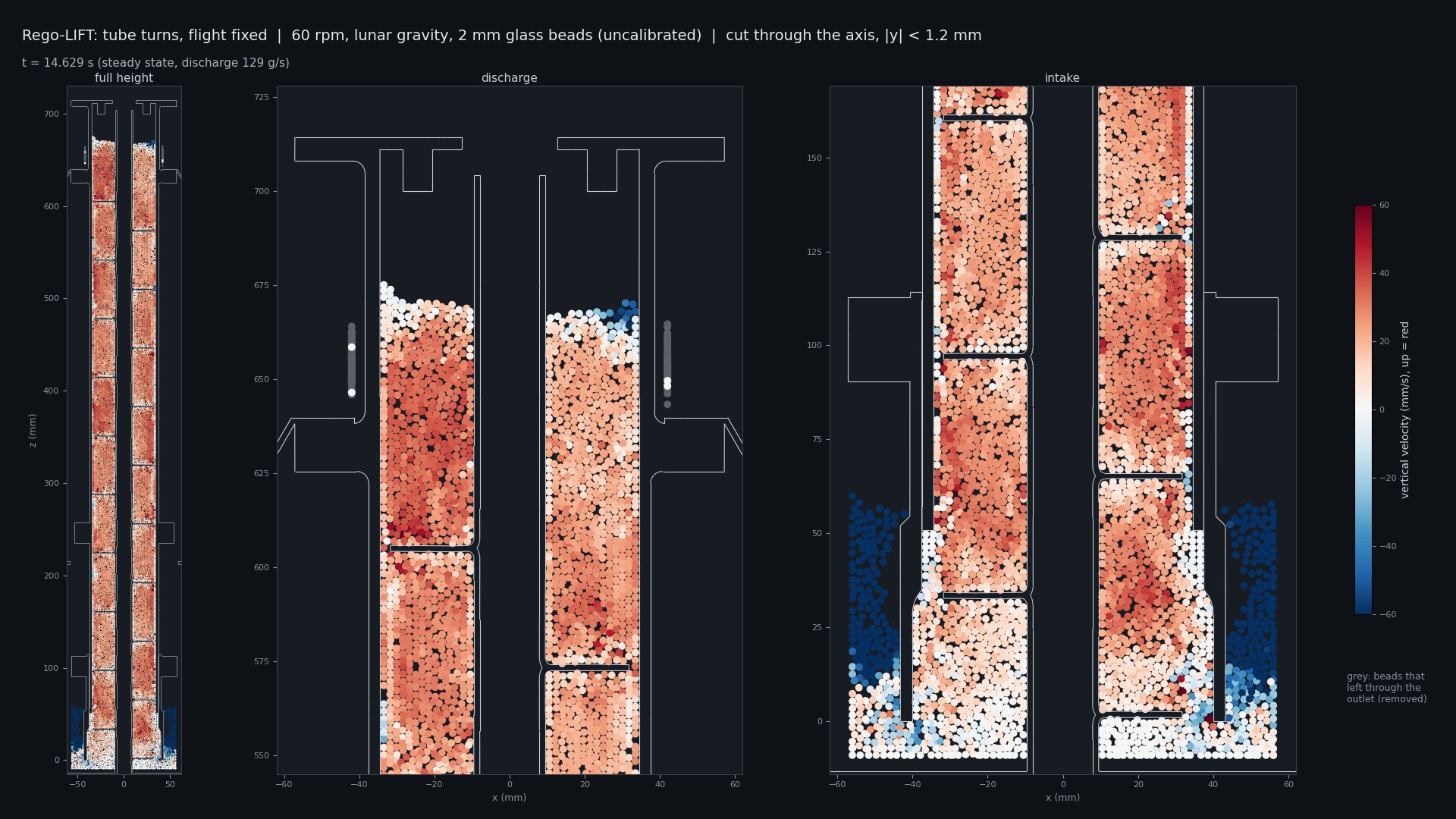
Rego-LIFT · 60 rpmSteady flow
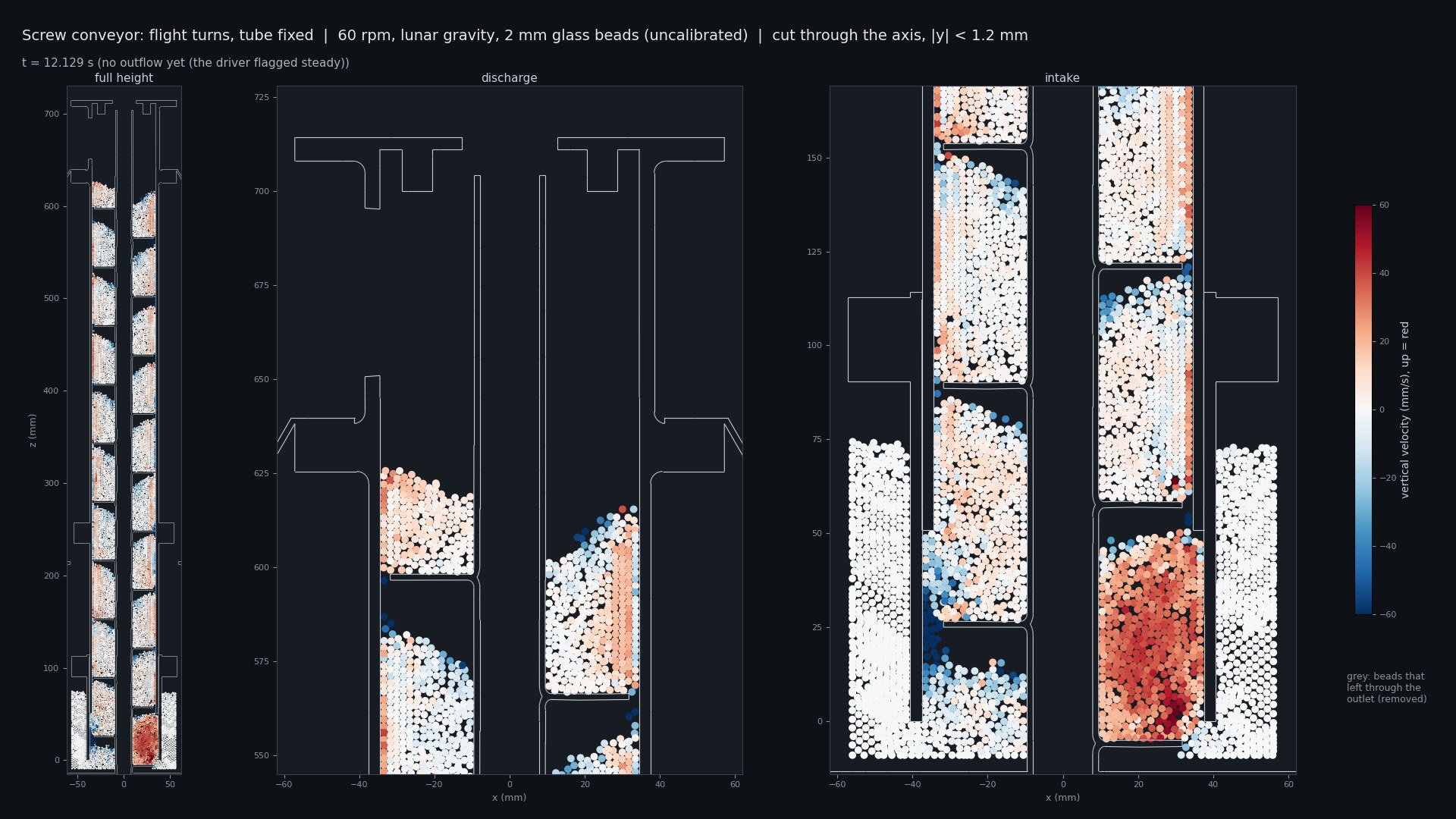
Screw conveyor · 60 rpmNo outflow
Velocity slice
A thin cut through the axis of each device, with every bead coloured by its vertical speed. Rego-LIFT's tube is packed with rising beads. In the screw conveyor, the beads sit in heaps on each turn of the flight, and most are barely moving or sliding back down.
From an earlier pair of 60 rpm runs that started with both tubes already filled. Full figures, including the whole height: Rego-LIFT ↗ · Screw conveyor ↗
Same machine, one-sixth the weight.
Gravity on the Moon is about one-sixth of Earth's. Everything that depends on weight changes: how grains settle on the flight, how hard they press on each other and the walls, and how they fall once they leave the auger. The figure shows the simplest of these, the fall.
The fall
Grains leave the chute at the same speed and height each time. Change the gravity to see how long they stay in the air and where they land.
Compared with Earth for the same exit speed (1.5 m/s) and height (1.2 m). Air resistance ignored.
The effects inside the tube are harder to predict, so Rego-LIFT is tested in lunar gravity. On NASA TechLeap parabolic flights, the aircraft flies about 30 lunar-gravity parabolas per flight while the payload records material flow, torque, and power.
Simulation, vacuum, flight.
Grain by grain
Regolith conveyance is modeled with the discrete element method (DEM) in Project Chrono's DEM-Engine, which tracks every grain individually.
No air
Regolith simulant is tested in vacuum, matching the airless lunar surface.
Lunar gravity
Parabolic flights validate the physics-based model for material flow, torque, and power.